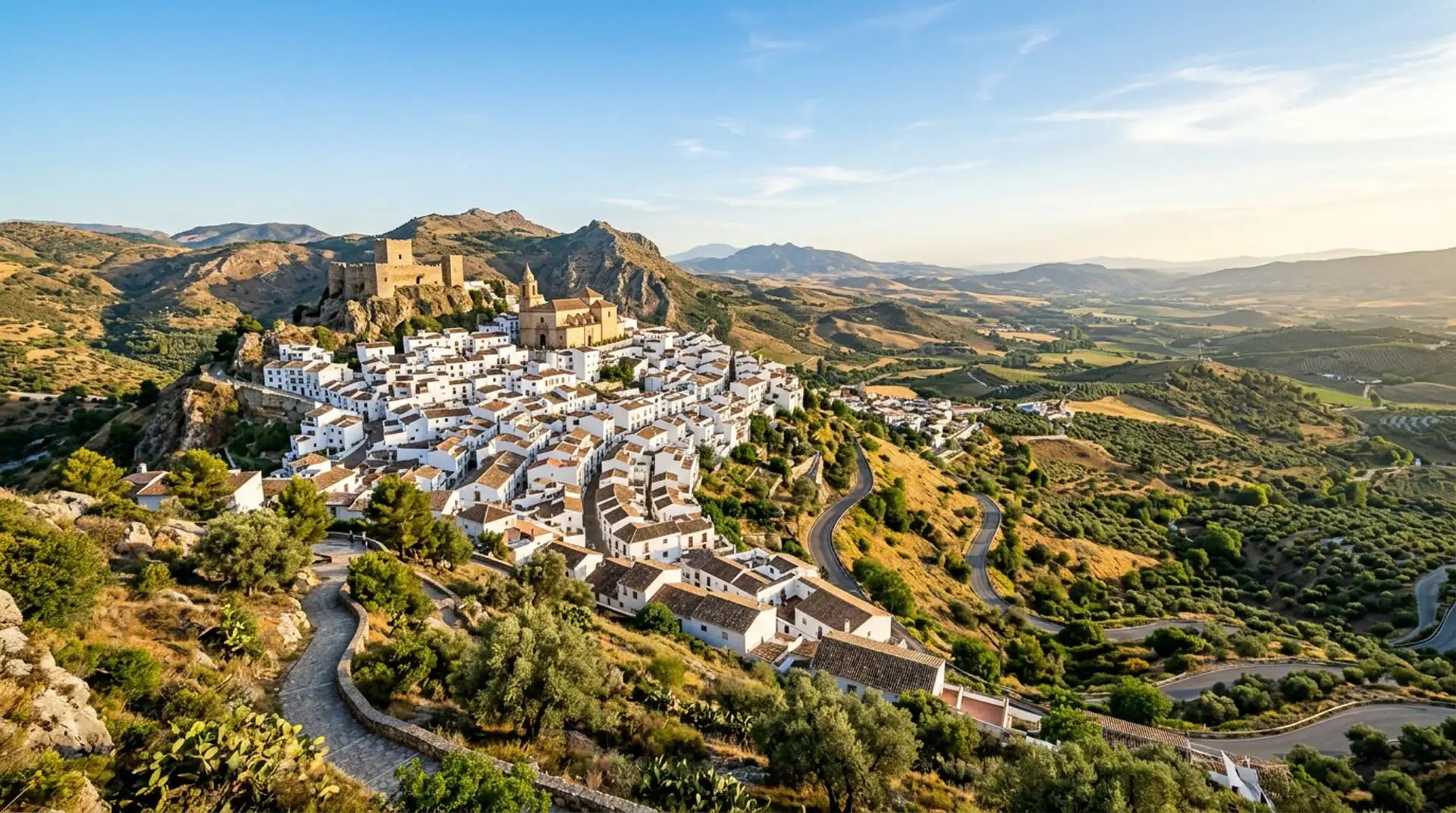
Living in Álora
Álora is a hilltop white town in the Guadalhorce valley, forty kilometres from Málaga city at an altitude of two hundred and nine metres. The municipality covers a hundred and seventy square kilometres and holds 13,650 people as of January 2025. Around eight and a half thousand live in the town itself; the rest are spread across settlements such as El Puente, Barriada Estación and El Chorro, and nearly a fifth live in scattered dwellings outside any village.
The practical draw is the railway, with a catch. Álora is the terminus of the Cercanías C-2 line, about forty-one minutes to Málaga María Zambrano and a few minutes more to Centro-Alameda, with trains from about a quarter to six in the morning until about twenty to ten at night. But the station is not in the town. It sits on the valley floor below the hill, in a settlement of about a hundred and forty people, and a dedicated bus links town and station. Nobody walks from the old town to a morning train.
Prices are the lowest of the valley towns in this guide by a wide margin: about three fifths of what Cártama asks per square metre, and well under half the coast. The population fell for years and only recently recovered its 2011 level. This is a cheap, slow, real town, not a growth story.
The verdict
Honestly considered, both sides.
The upside is real. So is the downside. Both matter more than any brochure will admit.
The case for
A genuine rail link to Málaga city
The Cercanías C-2 terminates here. About forty-one minutes to María Zambrano, a few minutes more to Centro-Alameda, with trains from about a quarter to six in the morning until about twenty to ten at night.
The lowest asking prices of the towns here
Per square metre, Álora asks about three fifths of what Cártama does, and well under half the coast. For a fixed budget that buys space nowhere else nearby can match.
A sizeable foreign community, not a colony
About one in eight residents is a foreign national. The British are the largest group, nearly a third of them, in a town where seven in eight residents are still Spanish.
A full run of schools in the municipality
Eight infant centres, five primary schools, three secondary schools and two sixth-form centres. A family can cover the whole school run without commuting to Málaga for education.
Big, varied countryside with the gorge at its edge
A hundred and seventy square kilometres including the Guadalhorce reservoirs and the Desfiladero de los Gaitanes gorge. The Caminito del Rey ends at El Chorro, inside the municipality, with its own railway station on the Córdoba line.
The case against
You cannot walk from town to the train
The station sits on the valley floor below the hill, in a separate settlement of about a hundred and forty people. A dedicated consortium bus covers the gap, so every rail trip starts with a bus ride or a drive.
No hospital anywhere in the municipality
There is a public health centre in the town and nothing more. Álora belongs to the Distrito Sanitario Valle del Guadalhorce, and its reference hospital is the Hospital Universitario Virgen de la Victoria in Málaga, which matters for older buyers and anyone with a condition.
A recovery, not a growth market
Population fell from about thirteen thousand five hundred in 2011 to near twelve thousand nine hundred in 2017. It has risen every year since, but it has only just passed the level it held in 2011.
No sea breeze, and a hill to climb
The Guadalhorce valley is inland and shadeless in summer, with no sea breeze forty kilometres away. Add a steep hilltop town and July errands on foot become a genuine slog. Budget for cooling and shade.
Thin market, slow exits, one blunt price figure
Cheap prices come with thin reporting: the index skipped July 2026 entirely. The index covers the whole large municipality with a single figure, no district breakdown, and skipped publishing July 2026 entirely.
Editor's note
Where you might be better off elsewhere
We like Álora for what it is: the cheapest of the valley towns we cover, with a real train to Málaga and a foreign community that is a minority of the town rather than the whole of it. But we would not put everyone here. Do not buy in Álora if you need to walk to a station, because the trains leave from the valley floor and the town sits on a steep hill above them. Do not buy here if you are older or managing a health condition and want a hospital close by, because there is none in the municipality. And do not buy here if you may need to sell quickly, because a market this lightly reported gives you little to price an exit against. Cártama is the answer for someone who wants the same train line with a hospital in the municipality, and a station inside a settlement rather than below a hill. Coín and Alhaurín el Grande give bigger service towns without a rail link. Ronda suits buyers who want a dramatic inland town and do not commute at all.
Lifestyle data
Property market
Updated 2026-08-30
Access
Community
Amenities
Álora on the map
Álora FAQ
Honest answers to the questions buyers actually ask.
Can I walk from Álora town to the railway station?+
How long does the train to Málaga take?+
Is the Caminito del Rey in Álora?+
Does the Caminito del Rey affect living in Álora?+
What healthcare is available in Álora?+
Are there other foreign residents in Álora?+
How reliable are the price figures for Álora?+
What are the costs of buying property in Álora?+
What are the ongoing costs of owning property in Álora?+
What taxes do I pay when selling property in Álora?+
Can I still get a Golden Visa by buying property in Spain?+
Transfer tax rates as of August 2026. Rates are set per autonomous community and do change. Confirm the current figures with a Spanish lawyer or tax adviser before you budget.
Local Experts
Deep knowledge of Álora and its real estate market.
Personalized Service
We accompany you throughout the entire process, from search to closing.
Exclusive Portfolio
Access to the best properties before they reach the market.
Spain's first AI-Powered platform
Our AI technology matches you with perfect properties faster than traditional search.
New to buying property in Spain?
Our step-by-step guide covers everything foreign buyers need to know, NIE numbers, Golden Visa, mortgages and the legal process.
Calculate your Spanish mortgage
Estimate monthly payments, compare loan scenarios and understand the true cost of buying in Spain.